


Traffic Arbitrage Terms: A Glossary for Beginners
"Ran it on the network via CPA, but approval tanked and half got shaved on hold" — a sentence a beginner won't parse at all, while an experienced buyer reads it as a perfectly clear complaint. Affiliate marketing speaks its own language: a mix of English acronyms, professional jargon and pure slang.
We've grouped the terms by meaning rather than alphabetically — that makes it easier to see how they connect and at which stage of the work each one shows up.
Core concepts
- Traffic arbitrage — buying traffic in one place and directing it to offers to earn the difference between cost and payout.
- Offer — an advertiser's proposal: the product, promotion terms and payout for a target action.
- Affiliate network — the intermediary between affiliate and advertiser: provides offer access, tracks conversions, pays out.
- CPA network — same thing, though the term usually refers to larger platforms with big catalogs from multiple advertisers.
- Advertiser — the product owner who pays for acquired customers.
- Affiliate (buyer, webmaster) — the person buying traffic and running it to offers.
- Media buyer — a paid traffic specialist, usually working within a team.
- Affiliate manager — the network employee who handles your account: sets terms, resolves disputes, advises on offers.
- Vertical — a thematic group of offers: gambling, nutra, dating, finance and others.
- Combo (bundle) — a working combination of every campaign element: offer, source, GEO, creative, landing page, settings.
- GEO — the country or region you're sending traffic to.
- Tier — country grouping by purchasing power: Tier-1 is the priciest markets (US, Germany, UK), Tier-2 and Tier-3 mean cheaper traffic and lower rates.
- Lead — a user who completed the target action you get paid for.
- Conversion — the target action itself.
- Profit — net earnings after all expenses.
Money and payout models
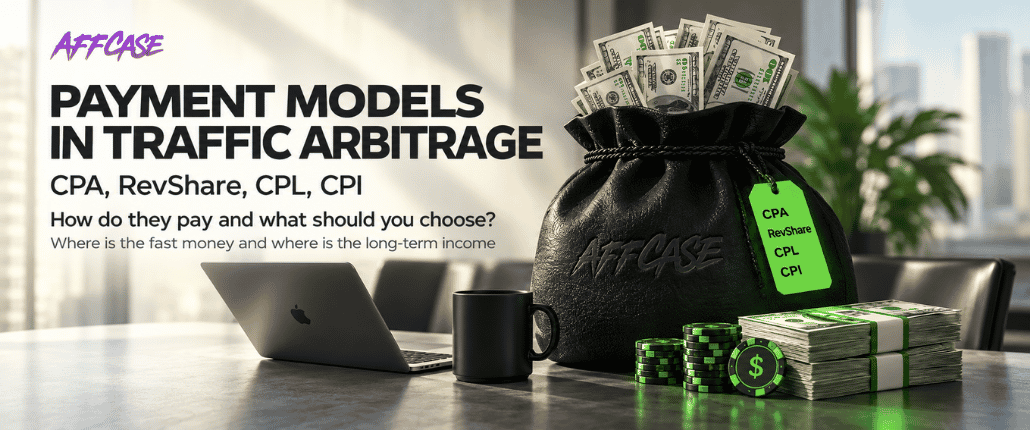
- CPA (Cost Per Action) — payment per target action: deposit, order, registration.
- CPL (Cost Per Lead) — payment per lead: contact details or a registration.
- CPI (Cost Per Install) — payment per app install.
- CPS (Cost Per Sale) — payment per completed purchase, usually a percentage of the order.
- CPO (Cost Per Order) — payment per confirmed order, before the goods are actually paid for.
- CPC (Cost Per Click) — a traffic buying model: you pay per click on your ad.
- CPM (Cost Per Mille) — a buying model: you pay per thousand impressions.
- RevShare — a percentage of the advertiser's revenue from your user, paid while they stay active.
- Hybrid — CPA and RevShare combined: a fixed payout for the first deposit plus a share of ongoing activity.
- SOI (Single Opt-In) — the lead counts as soon as the form is submitted.
- DOI (Double Opt-In) — the lead counts after email confirmation via a link.
- COD (Cash On Delivery) — payment on receipt, common in physical goods and nutra.
- FTD (First Time Deposit) — a player's first deposit, the key target action in iGaming.
- Hold — the period during which the network withholds payment to verify traffic quality.
- Approval Rate (AR) — the share of leads confirmed by the advertiser.
- Cap — a limit on how many conversions the advertiser will accept in a given period.
- Shaving — a network deliberately under-reporting the conversions it counts.
- Payout minimum — the smallest balance at which you can withdraw.
- Bump — an increased rate granted individually for volume or traffic quality.
Metrics
- CTR (Click-Through Rate) — share of impressions that produced a click. Measures the creative.
- CR (Conversion Rate) — share of visitors who completed the target action. Measures the landing page and traffic quality.
- ROI (Return On Investment) — return: how much profit each invested dollar brought.
- ROMI — same as ROI but counting marketing spend only.
- EPC (Earnings Per Click) — average revenue per click, handy for comparing offers.
- eCPM — effective revenue per thousand impressions, useful for comparing across models.
- LTV (Lifetime Value) — total value a user brings over time. Critical for evaluating RevShare.
- Click2Reg — share of clicks that reached registration.
- Reg2Dep — share of registrations that made a deposit.
- Retention — the share of users who return after some time.
- KPI — the advertiser's traffic quality requirements; missing them gives grounds to cut your payout.
Traffic and sources
- Traffic source — the platform where you buy ads: Facebook, Google, push networks, TikTok.
- Ad network — an intermediary selling traffic from many placements at once.
- Push traffic — ads delivered as push notifications to the user's device.
- In-page push — visually the same, but shown inside the webpage, so it works on iOS too.
- Pop (popunder) — a format where the advertiser's page opens without the user clicking an ad.
- Native — advertising disguised as the platform's own content.
- UAC — Google's automated app promotion campaigns.
- Organic traffic — traffic without direct buying costs: TikTok, Telegram, YouTube, forums. Free in money, expensive in time.
- SEO traffic — visitors from organic search results.
- Incentivized traffic — users who act for a reward rather than genuine interest. Usually prohibited by offer terms.
- Fraud — bad-faith traffic: bots, source spoofing, artificial inflation.
- Targeting — the settings that determine who sees your ad.
- Retargeting — showing ads to people who already interacted with the product.
- Whitelist / blacklist — lists of placements inside a network you allow or block.
- Spend — the process of budget being consumed by ad delivery.
- Running traffic — the act of sending traffic to an offer.
Creatives and landing pages
- Creative (creo) — the ad itself: image, video, copy.
- Landing page (lander) — the page where the target action happens.
- Pre-lander — an intermediate page before the lander that warms up interest.
- White page — an innocuous page shown to the platform's moderator instead of the real offer.
- Money page (black page) — the actual offer page the target user sees.
- A/B test (split test) — comparing two variants of an element to pick the winner.
- Angle — the idea a creative is built on: which emotion or motive it leans on.
- Creative fatigue — declining ad performance because the audience has already seen it.
- Case study — a public campaign breakdown with numbers and conclusions.
Technical tools
- Tracker — analytics software that follows the user's path from click to conversion.
- Postback — a technical signal from the network to your tracker that a conversion happened.
- Pixel — code on a page that records user actions and reports them to the ad platform.
- SubID — a tag in your link that shows exactly where a conversion came from.
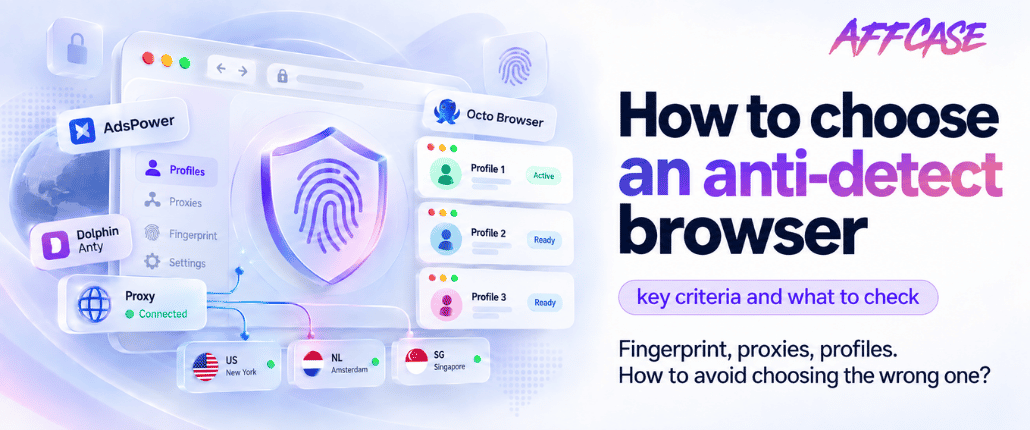
- Antidetect browser — a browser that spoofs your digital fingerprint so you can run multiple accounts.
- Fingerprint — the unique set of device and browser parameters platforms use to identify a user.
- Proxy — an intermediate server that substitutes your IP address.
- Cloaking — technology that shows different content to moderators and to target users.
- Spy tool — software for viewing competitors' running ads.
- PWA — a web app that installs on a phone like a native one. Widely used in gambling instead of store apps.
- Webview app — a shell application that opens a website inside it.
Accounts and overhead
- Overhead (consumables) — everything spent along the way: accounts, proxies, cards, domains.
- Farming — warming up an account by simulating normal activity so it looks legitimate and avoids bans.
- Auto-regs — automatically created accounts. Cheap and quick to get banned.
- Aged accounts — real people's accounts with activity history, pricier but more durable.
- Trust — the level of confidence a platform has in an account, built up through normal activity.
- Agency account — an ad account issued through a platform's partner agency. More lenient toward grey verticals.
- BM (Business Manager) — Facebook's tool for managing ad accounts and pages.
- Fanpage — the Facebook page your ads run from.
- Ad account limits — the cap on how much an account can spend on ads per day.
- Ban — the platform blocking your account.
- Checkpoint — a temporary block requiring identity verification.
- Drop — a person or their data used for registering accounts.
Slang
- To run / to push — to send traffic to an offer.
- To burn budget — to spend with nothing to show for it.
- To approve — to confirm a lead.
- To shave / to cut — to not count conversions.
- To break even — to finish a campaign at zero.
- Winning combo — a combination producing positive ROI.
- Running negative — operating at a loss.
- Team — an affiliate crew working together.
- Solo buyer — an affiliate working alone, without a team.
- Team lead — the person managing a group of buyers.
- Scam — fraud: a network that won't pay, a service that disappears with your money.
- Insider info — non-public knowledge: favorable terms, working angles, network problems.
FAQ
How many terms does a beginner need to know?
To get started, the core concepts, payout models and main metrics are enough — around thirty words. The rest comes with practice: source and overhead terminology becomes relevant once you actually work with them.
What's the difference between an affiliate and a webmaster?
Historically a webmaster worked with their own site and organic traffic, while an affiliate bought paid traffic. The line has blurred, and networks now often use the terms interchangeably.
What is a combo, in plain terms?
A working mix of every campaign element — offer, traffic source, GEO, creative and landing page — that brings in more money than it costs to run.
What does "running an offer" mean?
Directing purchased traffic to a specific advertising proposal to earn payouts for users' target actions.
How does approval differ from conversion?
A conversion is the target action happening. Approval is the share of those conversions the advertiser deemed legitimate and paid for. You can have a hundred conversions and sixty approved.
What counts as overhead?
Everything consumed during work beyond the ad budget: accounts, proxies, antidetect software, domains, payment cards. For grey verticals it's a separate cost line that has to be built into the combo's economics.
What's next
Terminology clicks once the words map onto actual tools and networks. The AffCase catalog collects affiliate programs, ad networks, tools and account sellers — with terms described and real reviews from arbitrageurs.
Got the vocabulary down? Open the catalog and build your combo.