

What Is a Combo in Traffic Arbitrage and How to Build One
"Found a winning combo" is the phrase the whole business runs on. But behind it isn't luck — it's specific mechanics: a set of elements matched to each other well enough that revenue from the traffic exceeds what you paid for it.
Here's what a combo actually is, what it's made of, how to build one from scratch, test it, and recognize when it's stopped working.
What is a combo in traffic arbitrage
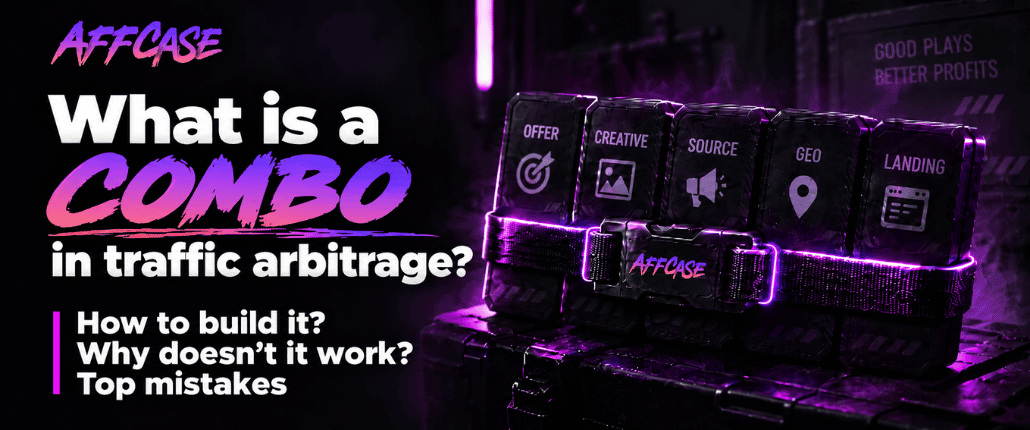
A combo (also called a bundle or funnel setup) is the combination of every element in an ad campaign that turns a profit: the offer, traffic source, GEO, creative, landing page and targeting settings. It counts as working when ROI stays consistently positive at real volume — not across a dozen random conversions.
The key word is combination. A great offer means nothing if you push traffic to it from the wrong source. A perfect creative won't save you if the GEO can't pay. A combo works or fails as a whole, and one broken element kills the entire structure.
That's why nobody in arbitrage is hunting for "a good offer" — they're hunting for a fit where every element reinforces the others.
The elements of a combo
The offer
The product you're promoting and the terms you get paid on. It's the starting point: the offer determines which GEOs are available, which sources the network allows, whether you need a pre-lander, and which motive your creative should push.
What matters isn't just the payout size, but the conversion action (deposit, lead, install, subscription), the hold — how long before the network pays out — and the approval rate, meaning how many of your leads actually get counted.
The affiliate network
The middleman between you and the advertiser: gives you offer access, tracks conversions, pays out. The same offer can run at different rates, under different traffic rules and with different payout speeds depending on the network.
The network affects your combo more than people expect: if it shaves leads or delays payments, a mathematically profitable combo stops being profitable in practice.
The traffic source
Where the people come from: Facebook, Google, TikTok, push and pop networks, native placements, Telegram, SEO, organic. Each source brings its own audience type, click price and moderation rules.
It's the second most important element after the offer, because the source determines whether you need antidetects, proxies, cloaking and agency accounts — in other words, what it costs just to have the ability to run.
GEO
The country or region you're sending traffic to. It affects several things at once: audience purchasing power, traffic cost, auction competition, creative language, and whether the offer is even legal there.
Tier-1 (US, Germany, UK) means expensive traffic but high payouts. Tier-2 and Tier-3 are cheaper to enter with lower rates, but less competition too. The same combo can run profitable on one GEO and deeply negative on another.
The creative
The ad the user clicks: image, video, copy, headline. It handles first contact and determines who actually lands on your page — the creative effectively filters your audience.
Format depends on the source: push networks use icon + headline + text, Facebook takes video or static with copy, and pop formats have no creative at all — the user goes straight to the landing page.
Landing page and pre-lander
The landing page is where the conversion happens: a lead form, registration, a deposit button. The pre-lander is an intermediate page that warms up interest — a review-style article, a quiz, a before-and-after story.
Pre-landers aren't always needed. In nutra and sweepstakes they lift conversion significantly, because the audience needs the product explained. In gambling, warm audiences are often sent straight to the landing page.
Targeting settings
Age, gender, interests, devices, carriers, time of day, frequency. The technical layer that cuts out non-target users and brings conversion cost down.
This also covers something people forget: placement filtering inside the source. The same offer converts on some sites in a network and burns budget on others, so blacklists and whitelists are part of the combo too.
A combo broken down
Here's what it looks like in practice — a hypothetical nutra campaign laid out element by element.
| Element | Value | Why |
|---|---|---|
| Vertical | Nutra | Low entry threshold, cheap testing |
| Offer | Joint supplement, CPA per confirmed order | Clear pain point, broad 45+ audience |
| GEO | Tier-2, local language | Cheap traffic, moderate competition |
| Source | Push network | Low click cost, volume for testing |
| Creative | Icon showing the problem + short headline | Push format demands instant readability |
| Pre-lander | Story-style article with testimonials | Audience needs the product explained first |
| Landing page | Network default + order form | Already optimized for conversion |
| Targeting | 45+, mobile devices, evening hours | Matches the offer's audience profile |
Change one row here — swap the GEO for Tier-1, say — and the economics stop working: the click costs several times more while the offer payout stays the same.
How to build a combo from scratch
Step 1. Start with what you already have
Build from your constraints, not from the offer. Answer three questions: which traffic source can you actually work with, how much can you spend on testing, and which GEOs can you cover by creative language. Everything else gets selected to fit that frame.
Step 2. Form a hypothesis
A hypothesis is your reasoning for why this should work: "the 45+ audience in this GEO actively clicks push notifications and buys health products via COD, because they don't trust online payment." Without one, testing turns into random spending — you don't know what you're actually checking.
Step 3. Assemble the pieces
Match an offer to your hypothesis, find a network with decent terms on it, prepare three to five creative variants and a pre-lander if the vertical calls for one. This is also where your tracker gets set up — without it, evaluating results is pointless.
Step 4. Test one element at a time
The core rule of testing: change one variable per run. Launch five creatives on identical settings, see which gets the best CTR. Keep the winner, test two pre-landers, see which converts better. Change everything at once and the result tells you nothing about causes.
Step 5. Count, don't eyeball
A combo is judged on numbers, not gut feel. The minimum metric set:
- CTR — creative click-through rate, shows whether it hooks the audience
- CR — click-to-action conversion rate, shows landing page quality and traffic-offer fit
- CPA / CPL — what one conversion actually costs you
- EPC — earnings per click, handy for comparing combos against each other
- ROI — the bottom line, the actual answer to "does this work"
- Approval rate — for CPA offers with a call center: how many leads got counted
Step 6. Scale carefully
A working combo scales two ways. Vertically — raising budget and bids on the same source and GEO. Horizontally — porting the combo to neighboring GEOs, duplicating campaigns, adding new placements.
Sharp budget increases often break a working campaign: the source's algorithms start buying different traffic. So scale in steps, watching whether ROI holds at the new spend level.
Why combos stop working
A combo isn't a permanent asset. It has a lifespan, and that's a normal part of the job, not a sign you did something wrong. The main causes of burnout:
- Audience fatigue. The same creative hits the same people too often, CTR drops, conversion cost climbs.
- Competitors copying you. Successful approaches land in spy tools fast, other buyers follow, the auction overheats and bids rise.
- Source-side changes. An algorithm or moderation policy update can zero out a combo overnight.
- Offer-side changes. The advertiser cuts the rate, tightens traffic requirements, approval drops, or the offer closes entirely.
- Seasonality. Off-season in betting, school holidays in essay: demand falls because of the calendar, not the combo.
Practical takeaway: while your current combo runs profitable, you test the next ones in parallel. Working a single combo means downtime the moment it dies.
Common mistakes with combos
- Drawing conclusions from a tiny sample. Five conversions isn't statistics. Decisions to kill or scale get made on volume that produces a meaningful result.
- Changing everything at once. Swapping creative, landing page and targeting simultaneously leaves you blind to what actually mattered.
- Copying someone's combo wholesale. Case studies are useful as hypothesis sources, but by publication time the approach is usually overheated. Copy the logic, not the specific creatives.
- Running without a tracker. Without end-to-end analytics you can't tell which placement, creative or pre-lander produces conversions and which drains budget.
- Skipping placement cleanup. On network sources a large share of budget goes to placements that never convert — those need cutting regularly.
Pre-launch checklist
- ☐ Hypothesis written down: why this combination should work
- ☐ Offer is allowed on the chosen source and in the chosen GEO
- ☐ Network terms checked: rate, hold, approval, traffic requirements
- ☐ Several creative variants prepared for testing
- ☐ Decided whether this vertical needs a pre-lander
- ☐ Tracker configured, tags in place
- ☐ Test budget set, plus the point at which the combo gets called dead
- ☐ A plan for what to change first if results come back negative
FAQ
What is a combo in traffic arbitrage, in simple terms?
It's a working combination of every part of an ad campaign — offer, traffic source, GEO, creative and landing page — that brings in more money than it costs to run.
How much does it cost to test a combo?
Depends on the vertical and source. In nutra or e-commerce on push traffic, a test budget runs in the tens of dollars. In gambling on Facebook it's hundreds and up, because both the click and the conversion cost more.
How long does a combo last?
From a few days to a few months. It depends on the source, your volume, and how fast competitors copy the approach. There's no standard lifespan, which is why metrics get watched constantly.
Where can I find ready-made combos?
Working combos aren't published openly — nobody shares one while it's still making money. What you take from case studies, chats and spy tools isn't the combo itself, but hypotheses and approaches you then test for yourself.
What matters more — the offer or the creative?
The offer sets the ceiling: if the rate is low and approval is bad, no creative will fix that. But with a decent offer, the creative is usually what separates a loss from a profit.
Can you build a combo with no budget?
Without paid traffic, yes — through organic: TikTok, Telegram, YouTube, forums. The combo logic stays identical, you just pay in time and manual work instead of click cost.
What's next
A combo is assembled from concrete things: a network with decent terms, an ad source for the right format, a tracker and an antidetect, accounts for your source. The AffCase catalog keeps all of it in one place — with real reviews from arbitrageurs and manager contacts, so you're not piecing it together across chats.
Got a hypothesis? Open the catalog and pick the elements for it.